
Some of the biggest problems in relationships, families, friendships, workplaces, and even within ourselves are not caused by hatred.
They are caused by conversations we keep avoiding. Not all silence is peace: Some conversations heal or break us.
The truth is, difficult conversations are uncomfortable because they force us to sit with vulnerability, accountability, fear, disappointment, grief, rejection, boundaries, unmet expectations, and honesty. But avoiding them often creates deeper wounds than the conversation itself ever would.
I have seen people stay silent in marriages until resentment replaced love.
I have seen friendships break because assumptions were louder than communication.
I have seen individuals struggle mentally because they kept suppressing emotions they were never taught how to express safely.
Learning how to have difficult conversations is an emotional survival skill.
It is the ability to say:
• “You hurt me.”
• “I am not okay.”
• “I need help.”
• “This relationship is draining me.”
• “I need boundaries.”
• “I forgive you, but healing will take time.”
• “I disagree.”
• “I need to be heard too.”
These conversations are not easy.
Sometimes they lead to misunderstanding before clarity. Sometimes they expose truths we were trying to avoid. Sometimes they reveal incompatibility, pain, or emotional immaturity.
But they also create healing.
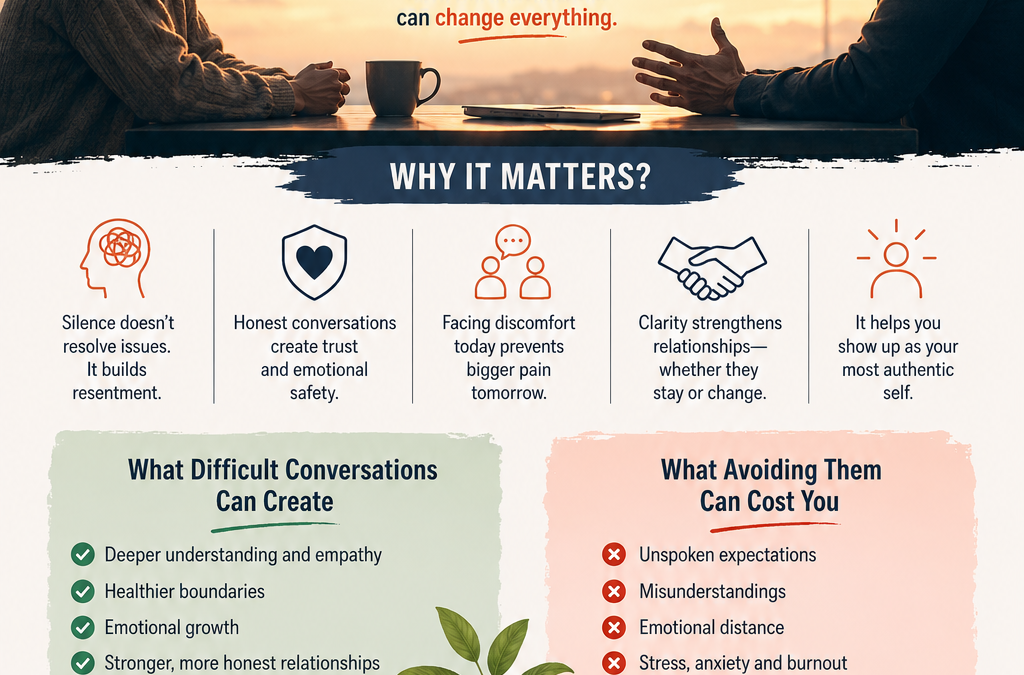
Healthy difficult conversations can:
✔ Build emotional intimacy
✔ Prevent silent resentment
✔ Improve mental health
✔ Strengthen marriages and relationships
✔ Increase self-awareness
✔ Teach emotional regulation
✔ Create safer communication patterns
✔ Help people feel seen, valued, and understood
At the same time, avoiding difficult conversations can lead to:
✘ Anxiety and emotional burnout
✘ Passive aggression
✘ Emotional distance
✘ Miscommunication
✘ Broken trust
✘ Internalized pain
✘ Loneliness even in relationships
One thing I have learned from working with people and from personal life experiences is this:
Peace is not always silence.
Sometimes peace comes after honesty.
We cannot heal what we refuse to discuss.
So maybe today is the day to stop rehearsing conversations in your head and start having them with wisdom, empathy, emotional maturity, and courage.
In therapy and in love, silence is rarely peace—it is often pain unspoken.
Choose connection over comfort.
Most broken relationships don’t fail from lack of love—they fail from avoided conversations.
Speak gently, but speak honestly.
Difficult conversations build stronger relationships, not weaker ones.
These fears are valid. Many of us were not taught how to hold emotional honesty without shame or punishment. So we learned silence instead. We learned to adapt, suppress, and endure.
But what we often don’t realize is this: what we suppress does not disappear. It accumulates.
Speak kindly.
Listen intentionally.
Communicate honestly.
Heal genuinely.
A Different Way Forward
Having difficult conversations is not about being harsh or confrontational. It is about being clear, calm, and intentional. It is about saying:
“This is how I feel…”
“This is what I experienced…”
“This is what I need…”
Without blame. Without emotional escalation. But also without self-abandonment.
It is a skill—one that can be learned, practiced, and strengthened over time. And like any skill, it feels awkward at first, especially if you’ve spent years avoiding emotional expression.
But healing does not come from perfection. It comes from participation.
A Closing Thought
If you are currently sitting on something you’ve been afraid to say—to your partner, your friend, your family, or even yourself—ask this:
What is more painful: the discomfort of saying it, or the cost of never saying it?
Because most emotional breakdowns don’t happen in one moment. They happen slowly, in all the conversations we avoided.
And sometimes, the most loving thing you can do—for yourself and for others—is to speak.
Not to win. Not to fight. But to connect.
If this resonates with you, I invite you to reflect: What difficult conversation have you been avoiding—and what might change if you finally had it?
Let’s talk.
What difficult conversation changed your life, relationship, or perspective for the better?