
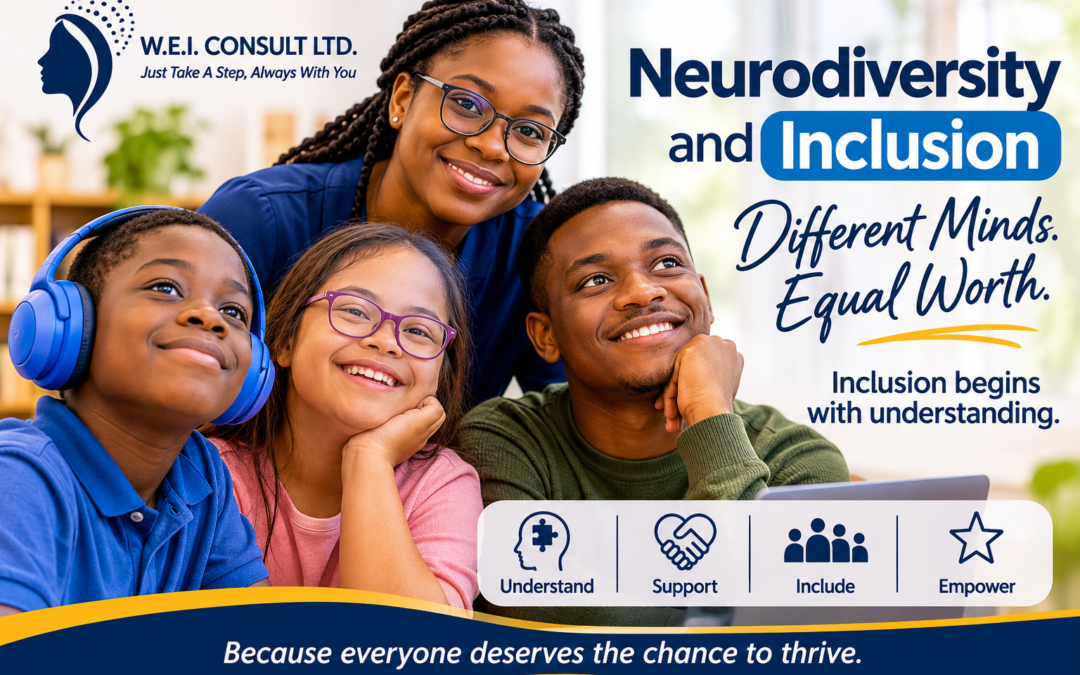
Some people are not struggling because they lack ability. They may simply be navigating environments that do not understand how they learn, think or function.
Imagine a child who is constantly reminded to sit still, pay attention and stop disturbing others. Or an adult who is intelligent, capable and hardworking but struggles with organisation, concentration or certain social situations.
How often do we pause to understand what might be happening beneath the behaviour?
Too often, we are quick to label people before making an effort to understand them. This is why conversations about neurodiversity and inclusion are becoming increasingly important.
Understanding Neurodiversity
Neurodiversity recognises the natural differences in how human brains function, process information, communicate and interact with the world.
It includes neurological differences such as Autism Spectrum Disorder (ASD), Attention-Deficit/Hyperactivity Disorder (ADHD), dyslexia and other developmental or learning differences.
These differences do not automatically mean a person lacks intelligence, potential or the ability to succeed. However, they may influence how an individual learns, communicates, manages everyday activities or responds to their surroundings.
Understanding this distinction is an important step towards building more inclusive communities.
The Importance of Early Understanding and Support
For children, an appropriate understanding of their individual needs can make a significant difference in their educational and social experiences.
A child who finds it difficult to concentrate may need a different approach to learning. Another who experiences sensory sensitivities may find certain classroom environments overwhelming.
Instead of relying solely on punishment, criticism or comparison, parents and educators should consider whether the child needs additional support or professional assessment.
The goal is not to excuse every behaviour but to understand the underlying needs and respond appropriately.
Late Diagnosis: When Adults Finally Begin to Understand Themselves
One conversation that deserves more attention is late diagnosis.
Some adults spend years wondering why certain experiences seem more difficult for them than for others.
They may have struggled with attention, organisation, sensory sensitivities, communication or social interactions without understanding why.
For some, discovering that they may be neurodivergent provides an opportunity to revisit years of experiences with greater understanding.
A diagnosis, when appropriately established, can help individuals understand their needs and explore suitable support.
It is important, however, not to self-diagnose based on isolated experiences. Professional assessment is valuable when persistent difficulties raise concerns.
Inclusion Must Go Beyond Awareness
Talking about neurodiversity is important, but awareness alone is not enough.
Schools must create learning environments that recognise different learning needs. Employers must consider reasonable adjustments that allow people to contribute effectively.
Sometimes, meaningful support may involve:
– Providing clearer instructions and expectations.
– Allowing flexibility in how tasks are completed.
– Reducing unnecessary sensory distractions.
– Offering additional learning support where appropriate.
– Encouraging open conversations without judgement.
– Recognising individual strengths alongside areas of difficulty.
Inclusion is not about lowering expectations. It is about removing unnecessary barriers that prevent people from participating and reaching their potential.
Listen Before You Label
Perhaps one of the most important things we can do is learn to listen.
People should have an opportunity to explain what they find challenging and what helps them function well.
A person should not have to struggle repeatedly before their experiences are taken seriously.
At W.E.I. Consult Ltd., we believe that understanding the individual is an important part of meaningful emotional and psychological support.
Every person deserves dignity, patience and an opportunity to be understood.
Different minds. Equal worth.
Perhaps the question we should be asking is not, “Why can’t this person fit in?” but rather, “What can we change to make this environment more inclusive?”
Recommended external reading
ACAS – Adjustments for neurodiversity at work.
NICE – Autism in adults: diagnosis and management.
Because inclusion begins when understanding takes the place of judgement.